April | Early Republic Era and Neoclassical Architecture
Neoclassical styles include a family of architectural designs influenced by Roman and Greek buildings of antiquity that were popular in the formative days of our nation. Each nuanced interpretation of Roman and Greek architecture falls into classifications of Georgian, Federal, and Greek Revival styles as influential designers took inspiration from the Classical Era for late eighteenth and early nineteenth-century buildings.
Properties protected by Preservation North Carolina exemplify the architecture of the early republic and the influence of classical architecture in our state. These properties participate in a wide-ranging conversation of classically inspired architecture that extends from the Low Country of South Carolina and Georgia into New England and across the Atlantic to the British Isles and mainland Europe. Through its protective covenants, Preservation North Carolina ensures dedicated stewardship, guiding the long-term care and preservation of these invaluable structures.
Georgian Architecture
English architects began composing designs inspired by the Italian Renaissance in the early 1600s. These designs brought new ideas to British architecture that were inspired by ancient Roman buildings, including symmetrical facades with columns, pilasters, cornices, and molded paneling. The language of Georgian design includes robust molding profiles generally based on circles, such as round arches, quarter rounds, and s-curves.
North Carolina did not see the adoption of such highly styled houses as quickly as Virginia and South Carolina. Here, classically inspired architecture slowly replaced medieval and asymmetrical forms beginning in the 1750s. According to architectural historian Catherine Bishir, as the “gentry class grew with the influx of educated and ambitious newcomers in the late colonial period, participation in the growing genteel culture of classicism grew stronger.” The style remained popular through the end of the eighteenth century until it was replaced in popularity by the Federal style around 1800. Today, several properties protected by Preservation North Carolina (PNC) offer insights into Georgian architecture in our state.
Built about 1785, the Coor-Gaston House in New Bern illustrates how builders incorporated stylish Georgian motifs into North Carolina’s architectural vocabulary. The two-story timber-frame house is oriented with its narrow, gabled facade to the street, with a half-width and two-story piazza located on its south side elevation. The piazza is embellished with Asian-inspired Chippendale lattice, a feature that was promoted in stylish English pattern books of the period. A notable classical element includes a Diocletian gable window that serves as an expected flourish above its street-front facade. Interior features set a new standard for the Georgian style in our state, including the parlor mantel and overmantel with bold crossetted corners. A crossetted corner, also commonly known as an eared or shouldered architrave, is a classical architectural detail in which the trim around doors, windows, or mantels is emphasized. These details resemble those found at the nearby Tryon Palace. The house was built by James Coor, an English-born naval architect, builder, revolutionary leader, and enslaver. Later, the house was home to William Gaston, a Catholic lawyer, legislator, congressman, jurist, and enslaver. The property is protected by a preservation easement donated to PNC in 2013.
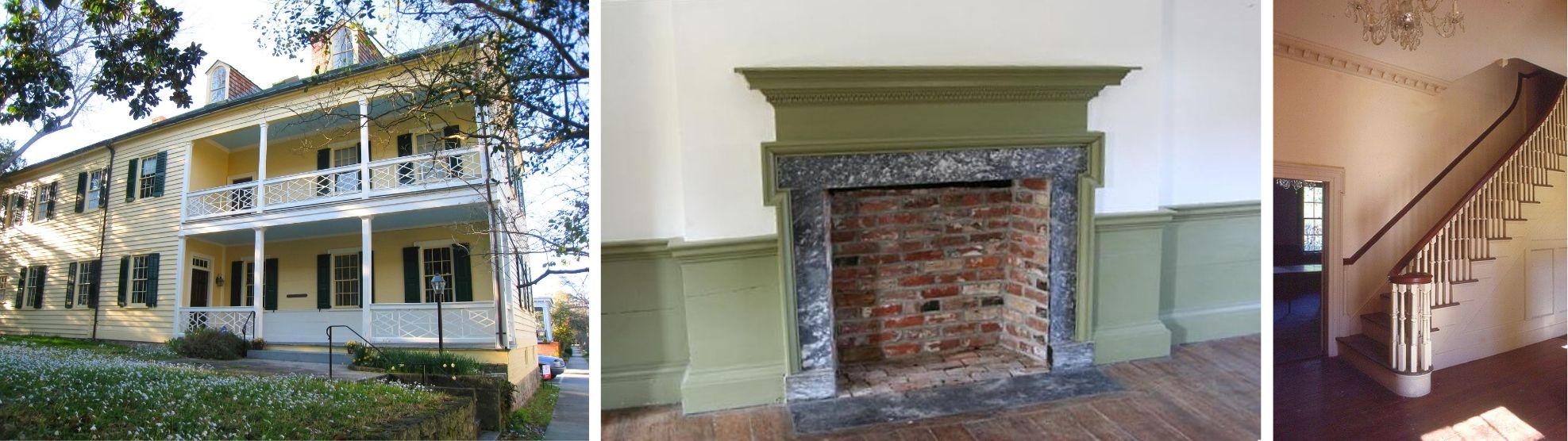
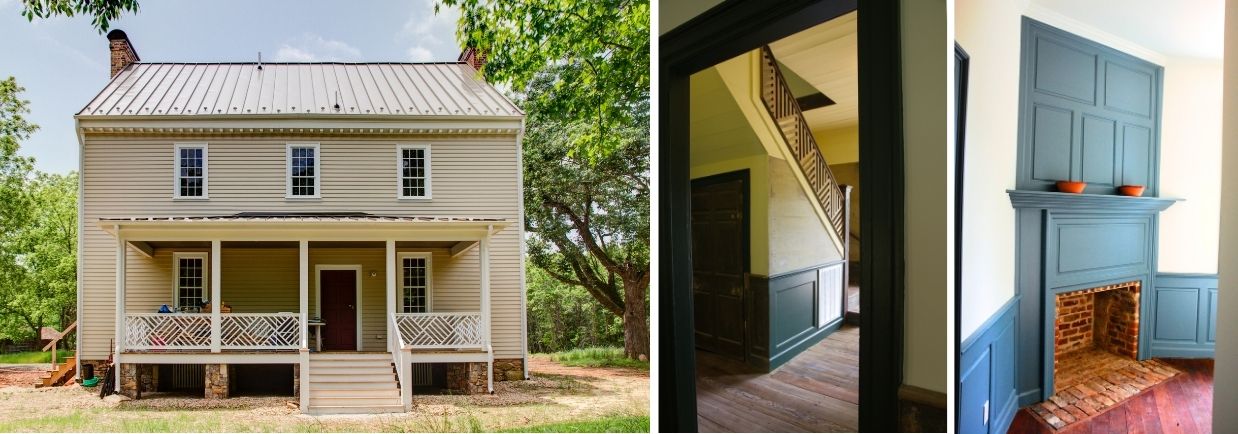
Elmwood in rural Granville County is another two-story expression of Georgian domestic architecture in our state. Built in 1805, it is illustrative of timber-frame examples of the style in that the exterior is pragmatic and modest with a few stylish details, such as its blocky modillion cornice, molded windowsills, beaded siding, and nine-over-nine windows. However, the interior details are more expressive, including an Asian-inspired Chippendale balustrade, raised panel wainscotting, and molding profiles that are based on circles. The centerpiece of its Georgian interior is the parlor mantel with bold crossetted corners and pulvinated frieze.
Elmwood was built by Willis Lewis, a colonel in the Revolutionary War, a Granville County representative in the general assembly, and a participant in the slave economy through his plantation. He was one of the largest landowners and most influential men in the county until his fortunes began to fall in the 1820s. In 1828, $30,000 in debt, he transferred ownership of the house, 5,000 acres of land, and 58 enslaved people to Sheriff Nathaniel Robards, and Lewis moved to Tennessee. Robards sold the plantation to William O. Gregory, a Virginian who owned 16,000 acres of land at the time of his death in 1884. After decades of use as a rental property, the house was abandoned until it received a major restoration in the 2010s, subsequent to protection by PNC’s preservation covenants donated in 2011.
Federal Architecture
In the mid 1700s, archaeological excavations in Europe revealed a previously unknown language of architecture that caused a reconsideration of the bold and rounded forms of the Georgian Period. These more delicate forms included slender attenuated columns and pilasters, swags, medallions, and refined molding profiles based on the ellipse. A new feature, decorative fanlights, adorned Federal Period facades. While glimpses of Georgian architecture were fleeting in North Carolina, a greater number of buildings protected by PNC represent the Federal period. The style grew popular in our state after 1790, and by 1820 it was the style of choice for impressive buildings.
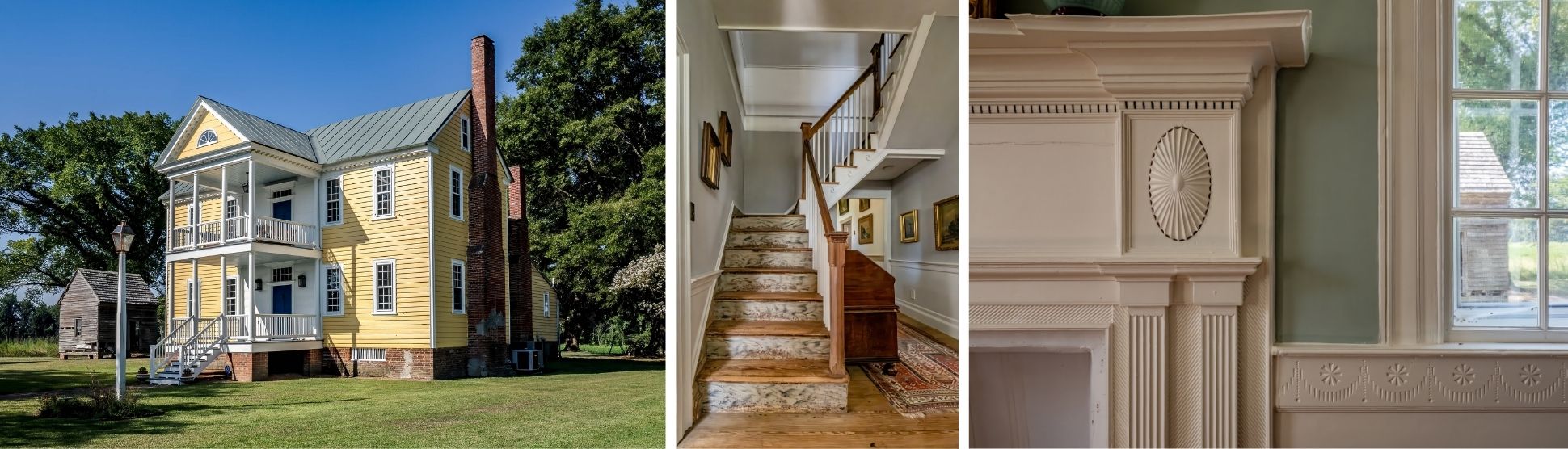
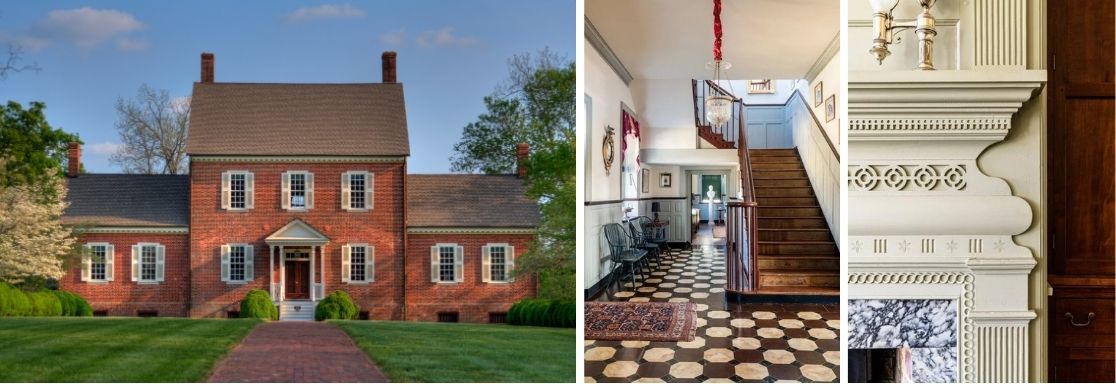
Greenwreath in Pitt County represents an early glimpse of Federal architecture in our state. The main section of the two-story, frame house is modest, but references are made to the graceful Federal style through a delicate scrolled modillion cornice, attenuated turned posts that support a double-tiered porch with a lunette window, and attenuated pilasters flanking the main entry. Federal features of the interior include a staircase with elegantly scrolled brackets, and a parlor with fielded wainscotting and chair rails with gouged-work designs of eight-petal flowers and swags. The parlor mantel is of particular note, with paired attenuated pilasters that support a three-part architrave with oval patera and dental molding.
The oldest and rear portion of the house was built in 1791 by John Foreman, a successful Virginia-born planter who participated in the slave economy with his bottomland plantation that had easy access to the Tar River. After Foreman died in 1818, the plantation was inherited by his eldest son, John L. Foreman, a graduate of the University of North Carolina. The son was active in Pitt County politics, representing the county in the House of Commons and the State Senate. After his death in 1844, the house remained in the family until 1948. The property has been protected by PNC covenants since 2013 and has undergone an extensive restoration.
Ayr Mount in Hillsborough is a Federal-style house commissioned by William Kirkland and completed in 1815. Kirkland immigrated to the United States and opened a store in Hillsborough as a participant in the slave economy. He named his plantation for his home of Ayr, Scotland. Kirkland employed William Collier as brickmason and John Joyner Briggs of Raleigh as the carpenter. The two-story brick house has flanking one-story wings. Its main entrance is centered on its symmetrical facade and contains double-leaf doors. Other details include a rectangular transom window and a small portico with attenuated square columns. The facade of the house includes a molded water table and stone lintels, all topped by a delicate scrolled modillion cornice. Interior features include ornamentation that is a vernacular interpretation of Federal design, including a mantel featuring delicate fretwork and dentils. The cornices in the parlors display an elegant pattern of arches and pendants. These features, the overmantel, and high wainscots are attributed to joiner Elhannon Nutt.
The Ayr Mount property, containing fifty acres, was restored by Richard Jenrette and is now managed as a museum by the Richard Hampton Jenrette Trust. The museum was managed by PNC in the 1990s, and PNC protects over 165 acres of land surrounding Ayr Mount with preservation covenants dating to 1997.
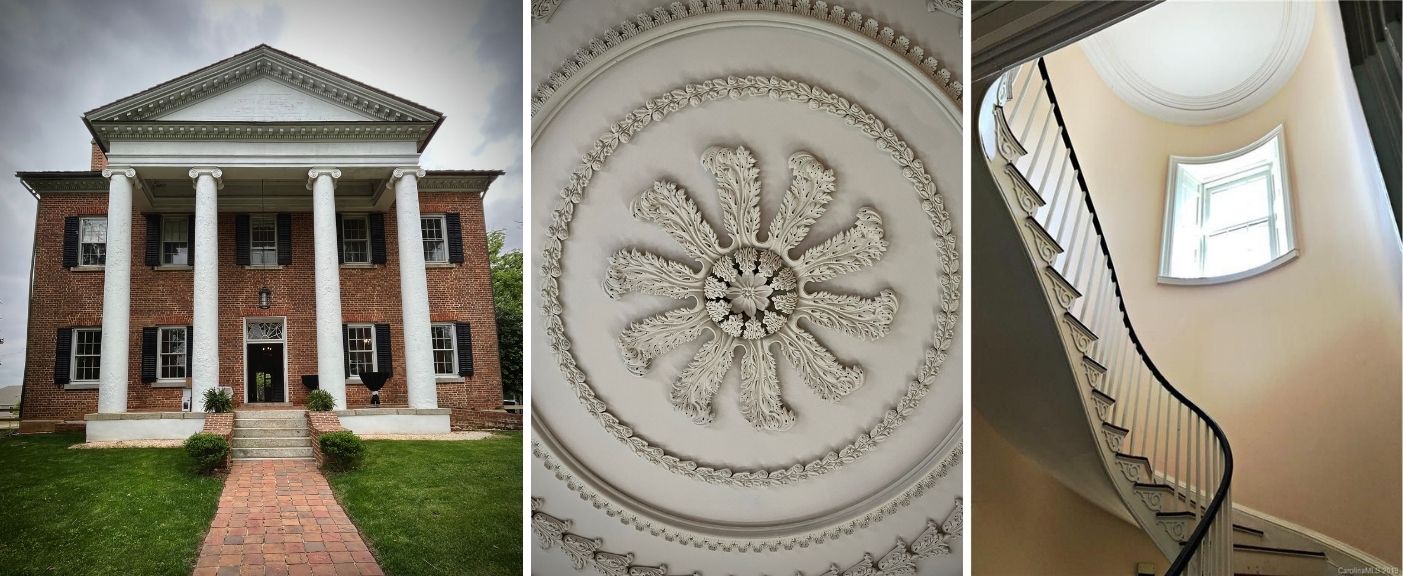
Ingleside in Lincoln County was built by Daniel and Harriet Brevard Forney about 1817. Forney was a descendant of an early family with associations in the American Revolution, the iron industry, and politics. The couple participated in the slave economy and moved to Alabama around 1834. In 1836, the house became the home of Alexander and Eliza Gaston. Alexander was the son of William Gaston of New Bern. The couple lost the property in 1838.
The Flemish-bond brick house is notable for having benefitted from a well-informed designer who not only composed one of the earliest examples of the monumental portico in NC – in this case, Ionic – but also was familiar with Owen Biddle’s Young Carpenter’s Assistant publication of 1805. The current owner has convincing documentation that Ingleside’s designer was architect Ithiel Town. Facade details include jack arches over windows and entryways, and an intricate demilune fanlight of leaded glass is centered above the front door. The cornice is of particular note for featuring elegant, scrolled modillions above dentils. Ingleside’s interior features represent a high-water mark for the Federal Period in North Carolina, centered on the elliptical curving stair with Owen Biddle-inspired scrolls ornamenting the open string of the stair. In the Drawing Room, engaged and fluted colonettes and rope molding embellish the Federal style mantel. Its three-part frieze with elliptical sunbursts with a dentil cornice is attributed to Jacob Stirewalt, a German craftsman who was responsible for pattern book designs seen in the houses in neighboring counties.
The property has been protected by covenants held by PNC since 2021.
Greek Revival Architecture
Following the War of 1812, Americans sought to break free from British influence, which had previously popularized Roman-inspired design. Instead of emulating the Roman Empire, they turned to ancient Greece as the cradle of democracy. This shift, bolstered by sympathy for the Greek War of Independence in 1821, made the Greek Revival style of architecture overwhelmingly popular in the 1820s, transforming it into America’s first true “national style”.
The Greek Revival style is characterized by stout and sturdy proportions, along with temple facades of columns that include Doric, Ionic, and occasionally Corinthian elements. These features were sometimes incorporated into a temple-like design. Buildings were often painted white or light gray to mimic the look of aged marble.
North Carolinians strongly identified with Greek Revival design, and buildings of the style appeared in almost all county seat towns in the form of courthouses, churches, banks, or impressive houses. Preservation North Carolina has worked with property owners of several Greek Revival buildings to ensure they remain part of our state’s architectural legacy.
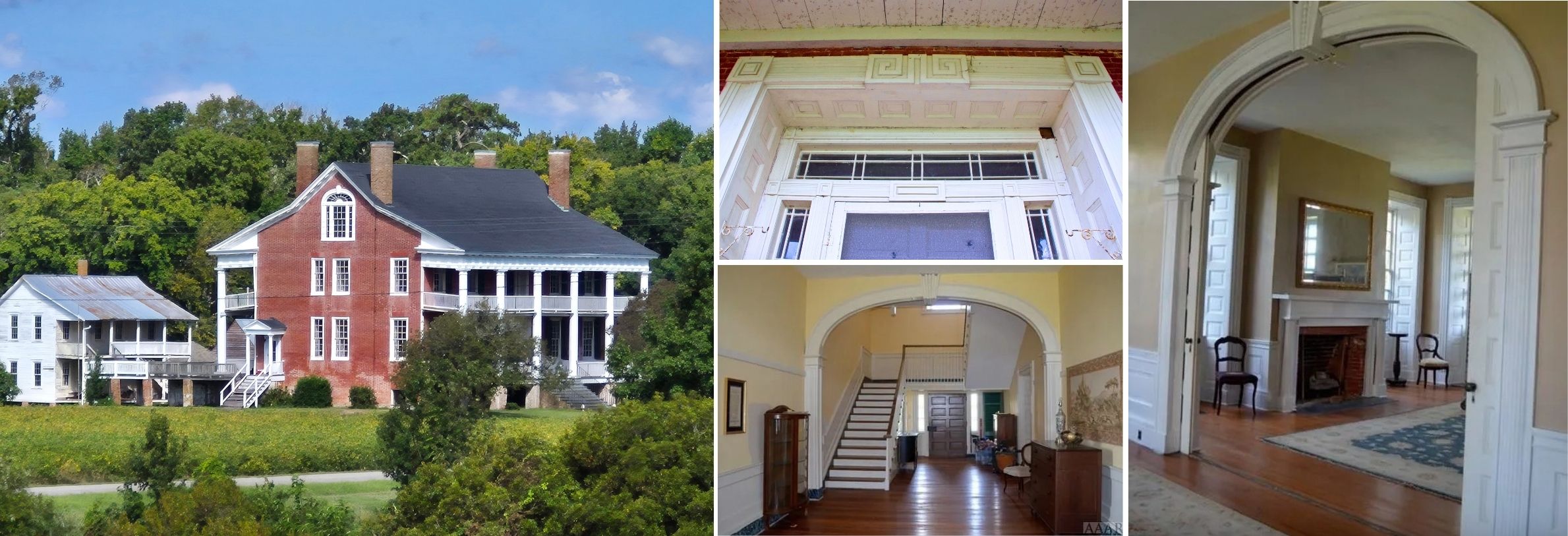
Land’s End in rural Perquimans County stands among the most impressive Greek Revival houses in North Carolina. Built in the 1830s, the brick house stands two stories in height and is recognized for its two-tier piazza that is supported by smooth Doric columns. The entrance is enhanced by Greek Key trim, and other Greek details found inside the house are reminiscent of Asher Benjamin’s Practical House Carpenter (1830).
Land’s End was constructed by Colonel James Leigh, a prominent building contractor, planter, and merchant. His holdings extended beyond his 5,000 acre plantation to include the Mansion House Hotel in Elizabeth City. Leigh represented his home county in the House of Commons in 1818 and was a justice of the peace, militia officer, deputy sheriff and a trustee of Concord Academy.
The property has been protected by an easement donated to PNC in 1995.
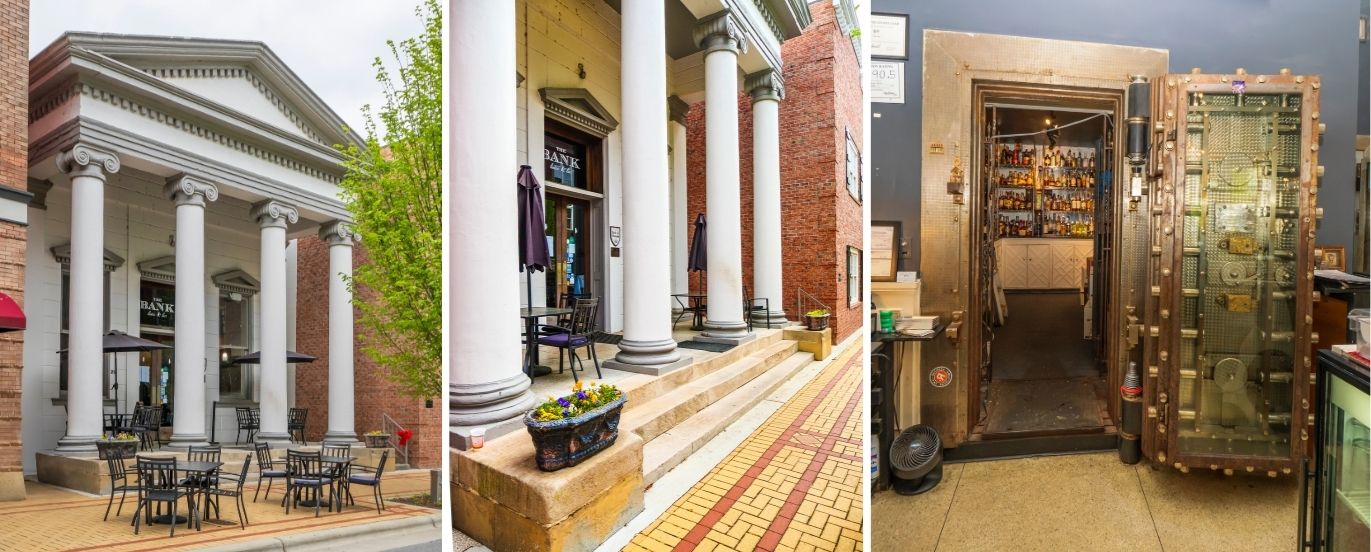
The Bank of Washington in downtown Washington is the state’s finest small Greek Revival commercial building. Incorporated by an act of the General Assembly in 1851, the bank’s new building was built between 1854 and 1855 with an impressive Ionic portico. Exterior walls are built of brick that is covered in stucco and scored to resemble stone. Early interior appointments include a classical cornice and classically inspired window surrounds. A large vault stands in the banking room.
The bank was acquired by North Carolina National Bank (NCNB) in 1971, and the building remained in use as a bank until 1980. In 1981, NCNB donated the property to Preservation North Carolina to ensure its preservation as a boost for Washington’s participation in the Main Street America Program. The property was sold to private investors with preservation covenants in 1988. Today, the building is home to The Bank Bistro.
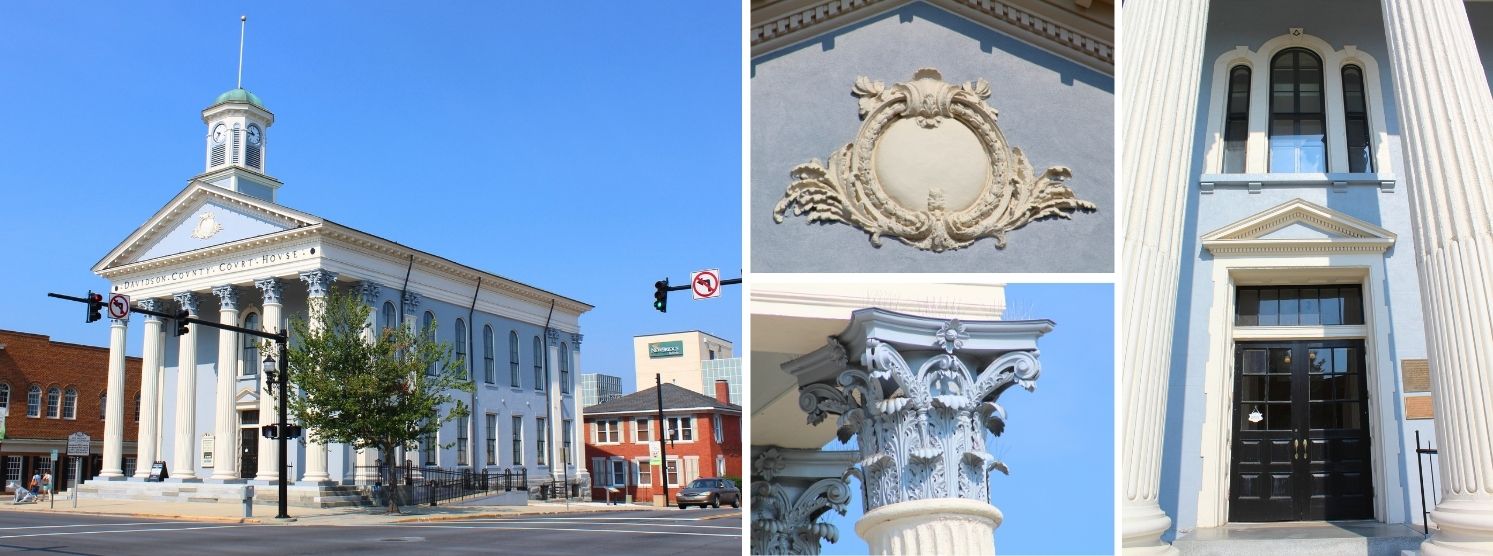
The Old Davidson County Courthouse was built by William Ashley and George Dudley between 1856 and 1858 on the courthouse square in Lexington. It was designed in the temple form with an impressive portico of Corinthian columns and entablature. It’s stuccoed facade was originally scored to resemble stone. Above the portico, an octagonal clock tower features louvered round-headed arches. Round-arched windows in the Italianate style hint at the next popular architectural style in our state.
Upon entering the building, staircases on the right and left sides lead upstairs to a grand courtroom space that now houses a museum. Details in the courtroom include windows with fluted pilasters and an entablature that runs the perimeter of the room. The Davidson County Historical Museum, founded in 1976, occupies the landmark building. The building has been protected by an easement with PNC since 1990.