

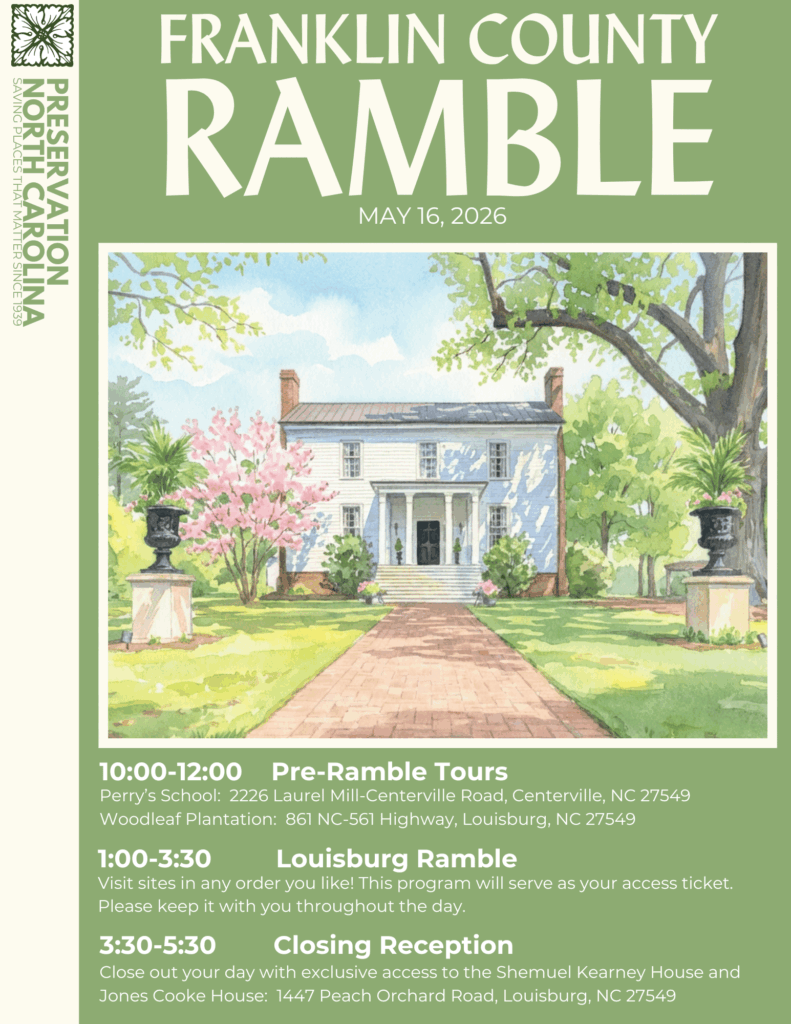
Franklin County Ramble
Don’t forget to grab lunch on your own before the Ramble!
Franklin County was formed (along with Warren County) in 1779, and with convenient access to lucrative markets in Virginia, residents adopted a plantation economy based on cotton and tobacco cash crops cultivated by enslaved labor by the nineteenth century. Franklin became not only one of the richest counties in the state, but it was also one of the few in North Carolina with a majority Black population. Primary crops included cotton, corn, wheat, and oats. A network of plantations formed an interesting body of architectural resources, complemented by institutions such as churches and schools, including the Franklin Male Academy (1805) and Louisburg Female College (1814), which now comprise Louisburg College. Enterprising citizens invested in the establishment of mills, stores, and cotton gins that complete a full expression of a rural landscape.
Established in 1779 as the county seat of Franklin County, Louisburg continues to serve as the administrative and educational heart of the county. Franklin County benefited early in its existence by being located midway between the state capital to the south and Roanoke River valley cotton to the north, but the Wilmington & Raleigh (later Wilmington & Weldon) and the Raleigh & Gaston railroads, both completed in 1840, bypassed the city to the east and west. The result is that Louisburg represents the smaller scale county seats of our state before industrialization increased their wealth and populations.
Architectural methods, forms, and styles in Louisburg and Franklin County were generally slow to change and frequently reflected established vernacular traditions. Timber frame structures were the construction method of preference until the ease and affordability of balloon frame construction changed preferences by the turn of the twentieth century. Within the same timeline, locally crafted mantels, surrounds, and trim packages were replaced by mass-produced construction products. In 1895, a Louisburg ordinance mandated that “no wooden building shall be built or placed, not any material used in construction of outside walls except stone, brick or cement” within the major streets of the town center.
Earliest substantial buildings reflect nationally popular styles such as Georgian, Federal, and Greek Revival, but glimpses of such styles are rare. Most buildings of the first century of Franklin County were pragmatic and traditional, built by highly skilled enslaved and free Black craftspeople such as James Boon. Aside from Jacob Holt and Albert Gamaliel Jones, both of Warren County, most buildings were designed and built by their occupants or through expertise found within their social circles.
By the turn of the twentieth century, pattern books and professional architects led many construction projects across the county. Architectural firms such as Barrett & Thomson Architects of Raleigh took larger commissions that required design and engineering expertise.
Use of stone. Franklin County is on the northeastern edge of the Carolina Piedmont, a plateau underlain by metamorphic and igneous rocks such as gneiss, schist, and granite. A few miles east, beyond the fall line, there are few rocks traditionally used in construction.
Pegged mortices. Look for the quarter-of-an-inch round profiles of pegs on window sashes, door frames, and sometimes paneling. The pegs pin the rails (side to side) with the stiles (up and down) and indicate hand crafted joinery.
Wavy Glass. Is the world viewed from this pane of glass distorted? That is not a flaw, but a cherished sign of hand-crafted glass! Early in our state’s history, glass was rare and sometimes was substituted with heavy waxed paper. As time went by, crown or cylinder glass was imported into the Piedmont, always perfectly imperfect!
Beaded siding. The oldest buildings in Franklin County sometimes have clapboard siding that features a bead carved into the bottom of the board. For the earliest Georgian-style houses, the curve is wide, up to a half inch in width. For slightly newer buildings of the Federal Era, the bead is narrow, roughly a quarter of an inch. After 1840, beaded siding began to disappear from our buildings.
Perry’s School had its start in 1884 when State Senator Joshua Perry and his wife, Betty, sold a parcel of land to the Franklin County Public School Committee. The parcel was adjacent to the Black church known as Perry’s Chapel. The ensuing school built there became a landmark in northeastern Franklin County as both a polling place and a reference point for Gold Mine Township.
In 1928, in partnership with the Rosenwald Fund, a wood-frame school was erected on the same site. Established in the 1910s by Chicago philanthropist Julius Rosenwald, president of Sears, Roebuck and Co., the Fund addressed the inequitable state of education for African Americans in the rural South. The fund offered architectural plans and matching grants, leading to the construction of more than 5,300 schools between the late 1910s and 1932, from Maryland to Texas. North Carolina accounted for over 800 of these projects—more than any other state.
This Rosenwald school building, known as Copeland-Perry School, served the community until it burned in 1939. As its replacement, the county school board adopted a plan prepared by Louisburg architect M.S. Davis for a Public Works Administration-funded school building at Perry’s in 1940. The PWA frequently adapted Rosenwald Fund plans for buildings it helped fund, and the plan for Perry’s School closely resembles the Rosenwald Fund Nashville Plan for a six-teacher school with auditorium. The main building on the campus is the only New Deal school for African Americans remaining in the county.
Today, the Perry’s School complex includes four buildings, one site, and one structure, and four objects that are listed on the National Register nomination completed in 2010: the one-story frame main building dating to 1941; a one-story, gable-roofed detached concrete block rear wing constructed behind the original building in 1949; a low, U-shaped, one-story, brick high school built in 1952; the roughly rectangular, gable-roofed brick gymtorium erected in 1963; the baseball field and its home plate fencing south of the high school; and the two sets of paired brick pillars at the school’s circular drive entrances erected by the 1957 and 1960 graduating classes.
Segregation was ended in Franklin County in 1968, and Perry’s School was closed at that time. The school stands as the sole survivor among Rosenwald-affiliated schools in the county. The school’s alumni have rallied behind its preservation and adaptive reuse as a community center. Work has been completed to repair the roof on the main school building, and next priorities include foundation work and interior spaces.
Nicholas Bryar Massenburg, the son of a prominent Raleigh physician, was only 10 years old when he first attended the Raleigh Academy in 1818. In 1831, he married Lucy Davis of Warren County, and the couple had 13 children, of whom nine achieved adulthood. Nicholas began acquiring acquiring land in Franklin County in 1830 that was to be the nucleus of what would become a 2,100-acre plantation by 1860. Massenburg inherited enslaved workers from his father and in 1860 he enslaved 46 people. The family worshipped as Methodists (a window in the Louisburg United Methodist Church is in honor of Nicholas), and he was politically active as a Whig. The family’s history is enhanced by Nicholas’ detailed daybook, which thoroughly documented daily plantation life, including the 1838 house expansion undertaken by carpenter William Jones and numerous skilled craftspeople who were enslaved by Massenburg. These diaries reveal a prosperous mid-nineteenth-century operation producing food, fiber, and fodder for domestic use, with cotton and tobacco sold as a cash crop.
Woodleaf was constructed as a one-story Federal cottage, perhaps as early as 1820. The twin front doors likely reflect expectations of privacy between the two rooms of the hall-parlor plan, one formal for guests, the other private for family. Exterior details include three cut stone chimneys with brick stacks that were rebuilt in 1954 after Hurricane Hazel. Other details such as door and window surrounds and the boxed cornice are traditional to the region. Interior details remaining from the Federal Era can be found in the formal parlor, such as a tripartite mantel with fluted pilasters and an enclosed stair with a built-in glazed cupboard located under the stair. Federal moldings have been retained in the form of wainscot and surrounds. In 1838, the house was expanded with a rear ell and a second floor. This construction project was well-documented in Nicholas’ daybook beginning in March and completed in November. Other mantels reflect post and lintel forms of the Greek Revival Period including columnar pilasters and corner blocks. Evidence remains of early marbling and wood-graining.
The grounds of Woodleaf contain a remarkable number of surviving outbuildings. A one-story frame office, a frame building that had dual use as storage, and smokehouse with a stone-lined smoking pit and salting trough. The nearby cotton gin is thought to date as early as 1838. The heavy timber frame structure sits upon stone piers. Space below the structure was used by oxen, mules, and horses to turn the gin. The lower level was enclosed in the twentieth century. The gin is among the oldest of 60 remaining in the state.
Woodleaf was among the earliest properties to be protected by Preservation North Carolina with covenants recorded in 1981.
On June 21, 1901, the Franklin Times reported “The first service in the new St. Paul’s Episcopal church will be held at 11am Sunday the 23rd”. This notable Gothic Revival-style building was designed by Barrett & Thomson Architects of Raleigh as the congregation’s second structure, replacing their 1853 sanctuary. The cruciform church features a corner square tower that is attached to an open Gothic arcade extending across the facade. The gabled facade has wood shingles and a central stained glass rose window. Other details include a rusticated stone supporting the tower and colonnade, an entry door of diagonal panels within a Gothic arch, and Gothic arched windows. The interior features a cathedral ceiling with exposed roof framing, ornamental tracery, and king post trusses. A triple Gothic arch leads from the transept to the altar. St. Paul’s is part of a family of impressive Episcopal churches, ranging from Edenton and Tarboro to Raleigh and Hillsborough, that represent the legacy of Anglican congregations from North Carolina’s colonial era.
The Old Methodist Parsonage is a modest house with a mysterious history. The house takes the appearance of a four-bay structure sitting on fieldstone piers, and features turned posts that support a full-width roof porch. However, the house is unusual for having two side-by-side entrances that are perhaps a reminder of its First Period form. Its earliest history remains a mystery, but architectural evidence found in its timber framing points to its First Period as two individual structures dating from the early- to mid-nineteenth century. This narrative would position it among the oldest houses in Louisburg. Its Second Period existed after the two structures were connected as a two-room house (with two front doors) by 1882. Its Third Period was defined when it was moved several hundred yards south from its previous location between 1882 and 1904.
Interior appointments reinforce a mid-nineteenth century date of construction, specifically the wide plank floor, wall and ceiling boards, HL hinges, double-panel Greek Revival doors, and an enclosed “boxed” staircase. Other details were likely added in later periods, specifically beadboard wainscotting, two-over-two windows, and shed additions to the rear.
James A. Thomas, editor of The Franklin Times, owned the house at the time of his death in 1909. Thomas was an active member of the Louisburg Methodist Church, and some recall the house being used by Methodist ministers when they came to preach in Louisburg.
The Old Methodist Parsonage has been protected by Preservation North Carolina covenants since 2018.
This house is representative of a symmetrical Neoclassical house type that is one story in height with a generous front porch, a pyramidal roof, and dormer windows stationed above each elevation. On February 1, 1901, The Franklin Times announced that “P. A. Reavis…will erect a dwelling on his lot on Main street adjoining the ‘B. P. Clifton lot.'” Peter Augustus Reavis was a broker and president of the business men’s Republican League for Franklin County at the time of construction. His family moved into the new house in April 1903.
On June 26, 1903, The Franklin Times stated “Mr. J. R. Collie has purchased the new residence of P. A. Reavis, on Main street, and has moved in.” James Redmond Collie served as town registrar, Justice of the Peace, and was the secretary-treasurer of the Hughes Davis general merchandise at the time he and his wife Eleanor bought the house. J.R. Collie was a member of the Louisburg Graded School System Board of Trustees responsible for increasing state funding for public schools across the state when the State Supreme Court decided in his favor in J.R. Collie v. Commissioners of Franklin County in 1907. The Collie family occupied the house until 1925.
Points of interest include embellishment of the front-facing dormer with sunburst motifs that are similar to those found on houses built by M. F. Houck, and the projecting main entry flanked by large single-pane sidelights. The interior is arranged along a central hall and includes corner blocks, beaded tongue and groove wainscoting, paneled and molded doors, and Victorian mantels.
The Collie-Best-Taylor House has been protected by Preservation North Carolina covenants since 1997.
In December 1899, The Franklin Times announced that “The Baptists and Presbyterians of Louisburg, have made an exchange of lots and the Baptists will erect a beautiful new brick church and parsonage on the Presbyterian lot, and the present Baptist church building will be used by the Presbyterians as their place of worship.” The new sanctuary was erected in 1901-1904 to designs provided by Barrett & Thompson Architects of Raleigh. It is the third building of the Louisburg congregation which first organized in 1836. The church is located on a high corner lot and accentuates its impressive location with a 50-foot bell tower. The facade is a happy jumble of rounded Romanesque arches, buttresses, corbels, and parapets. Its architecture stands as a pleasant contrast to the Gothic designs of other churches.
The interior has maintained high integrity and includes fine stained-glass windows and rich woodwork. The vaulted ceiling features tongue and groove sheathing that is braced by beaded beams and king post trusses. The choir loft is distinguished from the main sanctuary by a curved balustrade enhanced with quatrefoils. The new sanctuary opened in September 1903 when The Franklin Times announced that “the large new Pipe Organ recently purchased by the Baptist church here has arrived, and is being placed in the new Baptist church by Mr. F. J. N. Tallman, of Nyack, N.Y. This gentleman informs us that it is a fine instrument and has two manual key boards, two pedals and 503 pipes.”
The Franklin Times announced on July 28, 1899 “The old Methodist church building is being torn down this week and work will soon begin on the new church. We learn that the Methodists will hold services in the Court House while the new church is being erected.” The first service was held in the new sanctuary, the congregation’s third, in early July 1900. The architect for the Methodist Church was Benjamin D. Price of Atlantic Highlands, New Jersey. Price had a following among Methodists and published a catalog of church designs in 1889. The cruciform church features a large gable with a trio of lancet windows that is flanked by two towers, one 35 feet in height and one of 50 feet.
Outstanding stained-glass windows are present in all the elevations of the main sanctuary. Each window was financed by patrons who dedicated contributions in honor of various church members. Of special note among the seven windows is a depiction of a sheaf of wheat dedicated to Nicholas Bryar Massenburg of Woodleaf Plantation; a window of Easter lilies inscribed “L.F.C. 1899” presented by students of Louisburg Female College; and a window depicting an open bible displaying the names of the pastors, 1880-1903, with a ship’s anchor that is inscribed “Presented by Former Pastors.” The collection of windows is illustrative of the wealth of Louisburg and Franklin County at the end of the nineteenth century.
Built during 1954 and 1955, the Dr. Thomas and Lois Wheless House is a glass, wood, and stone Mid-Century Modernist dwelling that was influenced by the designs of German-American architect Mies van der Rohe. The one-story main house is rectangular in shape, with a low-pitched gable roof. A service ell and a carport extend from the house. The interior has asymmetrical open public spaces balanced with private personal spaces.
Thomas Wheless was a native of Louisburg and was educated at Wake Forest College and Bowman Gray School of Medicine, where he was a member of the first graduating class. He returned to Louisburg and served the community as a family physician from 1946 until his retirement in 1988. Tom’s hobby was woodworking, which is represented by many pieces of his furniture. Lois Brown Wheless was a native of Rocky Mount who attended Louisburg College and the University of North Carolina Women’s College in Greensboro. Lois was a seamstress with a personal sense of style and design. The couple married in 1945 and had two children. Beginning in 1967, Lois served on the Louisburg Town Council for thirty-eight years, for which the town named its meeting room in her honor. It was Lois who was excited by modern architecture, and it was her connections that brought Raleigh architect Milton Small to Louisburg for their commission. Small designed their house to bring the outdoors in and utilized native stone, birchwood, built-in storage, and a fireplace positioned at the heart of the home.
The Wheless House has been protected by Preservation North Carolina covenants since 2004.
After receiving degrees from Trinity College (1883) and the University of Maryland School of Medicine (1889), William Henry Nicholson returned to his native state and was granted a license to practice medicine within days of his arrival. On Jan 17, 1890, The Franklin Times reported “The Times learns that Dr. W. H. Nicholson, a most excellent young gentleman, will locate in Louisburg. We give him a hearty welcome as the community is always glad to have such additions…” Genevieve Perry was the youngest daughter of Doctor Algernon Perry of nearby Cascine plantation. The two Franklin County natives were married in 1891 and had no children. Nicholson was a Democrat, a Methodist, a member of the Louisburg Literary Club, and soon opened a drug store in the village.
On February 19, 1892 , The Franklin Times announced that “Dr. Nicholson has moved into his new residence on Main street. It is a very nice and elegantly arranged dwelling.” This two-story frame house was built in the asymmetrical Queen Anne style, centered with a three-story tower that is adjacent to a two-story clipped bay. Notable features include German wood siding, diagonal sheathing inside panels located beneath the bay windows, a wide porch supported by square chamfered posts with brackets, and a double-leaf front door with etched glass. Interior appointments include high ceilings with plaster walls, cornerblocks, beaded wainscot, and a period mantel with an overmantel that represent mass-produced trim products that were made affordable with mechanization. The impressive Federal Period parlor mantel is said to have been brought to the house from Cascine in 1897.
The Nicholsons lived in the house only a short time, selling the property to Thomas Bickett and his wife Fannie (Yarborough) Bickett in 1901. Thomas Bickett was a lawyer and served as governor of North Carolina from 1917 to 1921. Bickett ran as a Democrat and is remembered today for his attention to the concerns of farmers, as well as prison and hospital reform. In 1919 the house was purchased by lumberman George Taylor, whose family resided there for fifty-five years. It later served as the residence of Louisburg College presidents for a number of years.
This Federal and Greek Revival style house was home to the family of Captain Jones Cooke, his three consecutive wives, and their blended family. The Cooke House is composed of two sections; the oldest constructed around 1808, and the newer around 1841. The oldest portion of the house is at the back of the residence and is a story-and-a-half Federal-era frame cottage with a gabled roof line, boxed eaves, and a cut stone foundation with two end chimneys. Interior details include raised panel doors, Federal flat-panel mantels with friezes, flat-panel wainscot with plaster walls, and an enclosed boxed stair.
The ca.1841 addition is heavy timber-framed and two-stories in height. This portion of the house has exterior appointments that are traditional to the Piedmont and include a boxed cornice, a hipped porch with reconstructed boxed columns, and a high brick basement. Interior details include an open string stair with gently curved scrolls, and trabeated mantels with colonettes and corner blocks. The mantel in the main parlor of the Jones Cooke house has a strong similarity to mantels at Woodside in Caswell County, which contains woodwork designed by Thomas Day.
Both sections of the house were likely built by Jones Cooke. The earliest might date to 1808, around the time then 22-year-old Cooke married his first wife, the widowed Elizabeth Jeffreys Greene. At her death, Cooke married the widowed Sarah Cotton in 1829, and at her death, he married Connecticut-born schoolteacher Jane Kingsbury in 1841. It is thought that the later Greek Revival portion was built with her arrival. Over the course of his life, Cooke fathered nine children.
Jones Cooke’s father was a Virginian who left his eldest son land and enslaved workers when he died in 1798. He served as Captain in the War of 1812, represented state and local Baptist affairs as a Deacon of Flat Rock Baptist Church, and worked in local and state political circles as a Democrat. His primary role was as a planter and cultivated 1,800 acres through work of enslaved labor for cash crops of tobacco, cotton, and wheat.
The Jones Cooke House was first protected by Preservation North Carolina covenants in 1983.
With its gambrel roof and austere Georgian interior woodwork, the Shemuel Kearney House is thought to have been built in 1759 and would have been an elegant and ambitious statement in the eighteenth-century Carolina piedmont. Kearney was born around 1734 in Nansemond, Virginia and was a successful planter. Like all members of NC’s planter gentry, Kearney’s wealth, success, and influence were built upon a foundation of affordable land and enslaved labor.
The distinctive gambrel roofline was popular throughout the Hudson, Delaware and Tidewater regions, but is rare in the Carolina Piedmont. The house forms were most popular during the mid- to late-eighteen century, likely because the form was pragmatic: it provided more interior headroom and did not require long rafter spans. Interior details reflect Georgian features such as raised paneling, bolection (framed) molding, and round-beaded edges. Other interesting details include H-L hinges, a closed string staircase, exposed ceiling joists, and pegged joinery.
In 2009 the landmark’s original location near US Hwy 1 was rezoned for commercial use. The house was made available for restoration by relocation through Preservation North Carolina. It was dismantled and moved to nearby Louisburg by the owners of the Jones Cooke House.
The Shemuel Kearney House has been protected by Preservation North Carolina covenants since 2016.