PNC Travel: The Architecture of the Hudson Valley
The historical allure of the Hudson Valley begins with its early Dutch settlement. It was refined by its strategic importance during the American Revolution and later through its role as a gateway for trade and expansion along the Erie Canal and the New York Central Railroad to the Midwest. Its cultural and artistic legacies were enhanced through the creative works of Washington Irving, Thomas Cole, and Frederick Church. Today, ancient winding roads take you by picturesque farms, Victorian villages, and old-money mansions built by New York’s elite.
Our tour base will be the village of Hudson, located on the Hudson River and convenient to Albany and New York City by train. Hudson is evolving from a period of disinvestment to a haven for big-city hipsters who seek out small-town life. Hudson is not (yet) a posh and polished tourism center, and many locals are working hard to retain the community’s edgy side with an alternative arts culture. Our hotel is housed within a brick factory used in the 1930s for the making of pocketbooks and recently reimagined as the Pocketbook Hudson Hotel. The project was recently profiled in Elle Décor Magazine in which its designers described the building’s inherent beauty and its material palette.
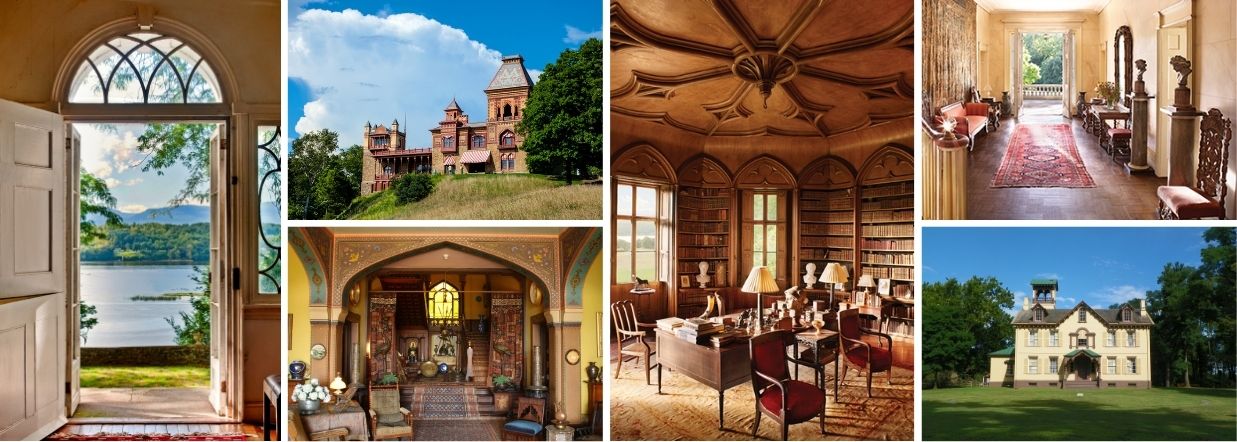
From Hudson, we will explore nationally important sites that represent American art and design, including the Thomas Cole house and studio, where we will learn about the Hudson River School of mid-19th-century American landscape painting. Overlooking the Hudson River, we will exploreOlana, the exotic estate and studio of landscape painter Frederic Edwin Church. Nearby is the once forgotten Dr. Oliver Bronson House, a Federal country house to which architect Alexander Jackson Davis composed an Italianate addition in 1849 that is an important “sister” to North Carolina’s Blandwood.
We will explore Wilderstein, the 1852 family seat of the Suckley family that was recomposed as a high-style Queen Anne mansion in 1888. Nearby is Edgewater, an elegant Neoclassical house built ca. 1824 overlooking the Hudson River. In 1853, it was the home of Susan and RobertDonaldson of Fayetteville, the richest man in North Carolina. Richard Jenrette, a North Carolina native, acquired the property in 1969 and made it his home until his death in 2018. Today, it is owned by the Richard H. Jenrette Foundation, which will host us at a riverside reception on thegrounds. Our journey will include a visit to Montgomery Place House and Gardens, an estate expanded in 1844 by architect Alexander Jackson Davis in the Italianate style. As a special experience, we have been invited to visit Staats Hall, the restored Greek Revival home of Pieter Esterholm. Pieter began his career working with Andy Warhol’s factory. He is now a photographer with commissions for British Vogue, Italian Vogue, World of Interiors, Architectural Digest, and Elle Décor. His book, “Life Along the Hudson: The Historic Country Estates of the Livingston Family” (2018), tells the story of architecture and politics of the Livingston family.